
Hiring senior engineering talent is one of the most expensive and time-consuming challenges technology companies face. The average time-to-hire for a senior software engineer in North America now exceeds 45 days. When you account for internal recruiter hours, interview coordination, failed placements, and delayed project timelines, the true cost of a single bad hire or extended vacancy can reach $50,000 or more.
Most companies accept this as the cost of doing business. At Happen Technologies, we treat it as a solvable problem.
Our structured hiring model consistently delivers qualified, vetted engineering candidates to clients in as little as 10 days – a process improvement of 400% compared to traditional recruitment timelines. This is not an accident. It is the result of a deliberate, repeatable process built around three principles: pre-vetting at scale, alignment before outreach, and speed without compromising quality.
This article explains exactly how we do it, and why it matters to your business.
The Real Cost of Slow Hiring: Numbers That Change How You Think About Recruitment
Before examining our process, it is important to understand what slow hiring actually costs.
Industry data consistently shows:
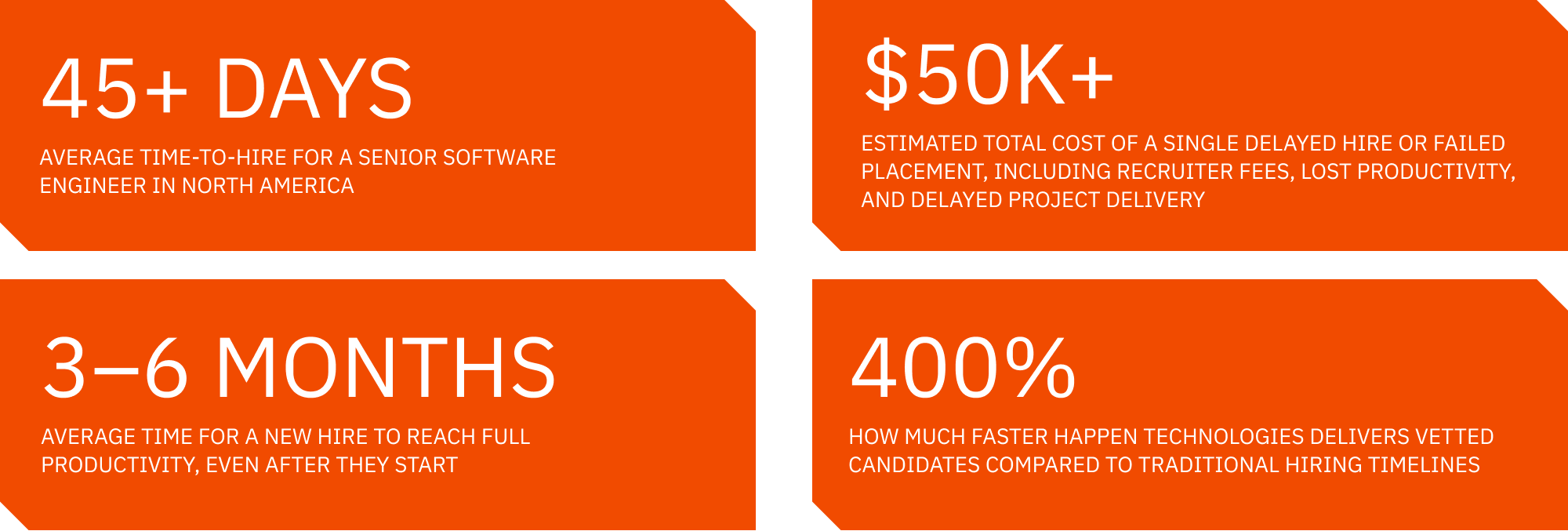
These numbers represent real business impact. A three-month engineering vacancy on a product team does not just delay a feature. It delays revenue, strains existing team members, and creates compounding risk across your roadmap.
The companies that understand this think about hiring as a strategic function, not an administrative one.
Why Traditional Hiring Is Structurally Broken for Engineering Roles
The standard recruitment pipeline was not designed for the speed that modern technology companies require. Most hiring processes involve:
- Posting a job description and waiting for inbound applications
- Manually screening dozens of unqualified candidates
- Coordinating multiple interview rounds across busy engineering managers
- Negotiating offers with candidates who are simultaneously interviewing elsewhere
- Losing top candidates to faster-moving competitors during long decision cycles
Each step introduces delay. Each delay increases the probability of losing the candidate, extending the vacancy, or settling for a suboptimal hire.
For enterprise organizations, the problem is compounded by internal approval processes. For startups, the problem is compounded by limited recruiter bandwidth and a smaller employer brand.
The result is the same: expensive delays, frustrated hiring managers, and talent that finds a better offer before you can move.
How Happen Technologies Reduces Time-to-Hire by 400%: Our Three-Stage Process
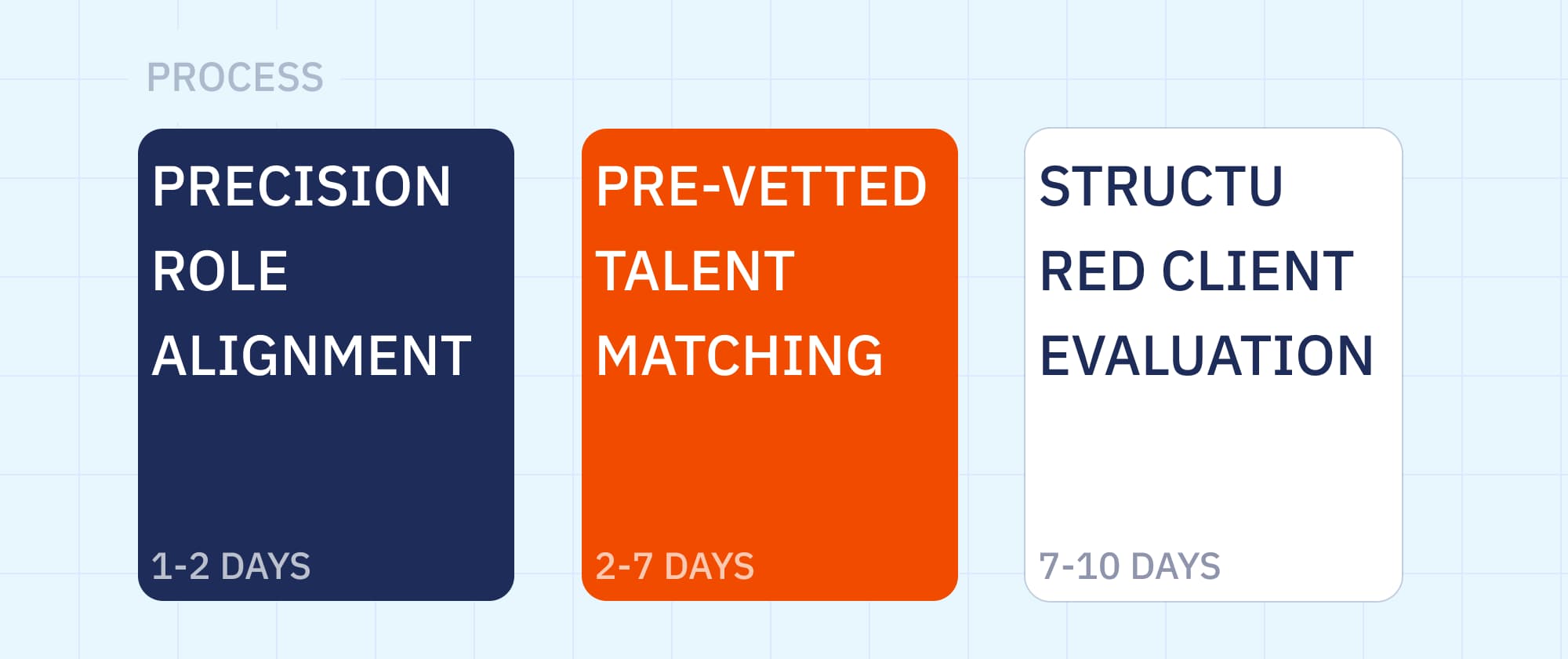
Our hiring model is built on a fundamentally different structure than traditional recruitment. Rather than starting from zero on each search, we maintain a continuously updated, pre-vetted talent network across Eastern Europe and Latin America – geographies that provide exceptional senior engineering talent at cost structures 30–50% below equivalent North American rates.
Here is how the process works.
Stage 1: Precision Role Alignment (Days 1–2)
Most hiring delays begin at the requirements stage. Job descriptions are written by committee, contain contradictory requirements, or list aspirational skills rather than practical necessities. When a recruiter receives an unclear brief, every downstream step is slower.
At Happen, we begin every engagement with a structured alignment session designed to produce a precise, actionable hiring profile. This session covers:
- Technical requirements: languages, frameworks, infrastructure, tooling
- Team structure and collaboration model: remote, hybrid, time zone expectations
- Project context: the specific problem this engineer will solve in the first 90 days
- Seniority signals: what good looks like for this specific role, not in the abstract
- Cultural and communication expectations: how this team works, not how the company describes itself
This session typically takes two hours. It produces a hiring brief that our talent team can act on immediately, without back-and-forth clarification cycles that typically add one to two weeks to a standard search.
Stage 2: Pre-Vetted Talent Matching (Days 2–7)
The second stage is where our model differs most significantly from traditional recruitment.
We maintain an active network of senior engineers who have already completed our vetting process. This is not a passive resume database. It is a curated pipeline of engineers who have been evaluated across four dimensions:
- Technical proficiency: assessed through structured coding evaluations and architecture interviews
- English communication: evaluated through live conversation, not written self-assessment
- Availability and commitment: confirmed, not assumed
- Work history and professional conduct: reference-validated
When a new role brief arrives, our matching process cross-references the requirements against this existing network first. In most cases, we identify two to four qualified candidates within 48–72 hours of receiving the brief.
When the role requires skills outside our current network depth, we initiate a targeted outreach campaign. Because we know exactly what we are looking for and who we are looking for, this outreach converts faster than generic job postings.
The result: clients receive their first candidate profiles within five to seven business days of role alignment, not five to seven weeks.
Stage 3: Structured Client Evaluation (Days 7–10)
The final stage of our process is designed to help clients make confident decisions quickly, without compressing the evaluation quality.
We present two to four candidates per search, not twenty. Each profile includes:
- A written summary of technical strengths and relevant experience
- Assessment notes from our technical evaluation
- Communication quality observations from our screening conversations
- Honest notes on any areas of concern or context the client should consider
We then coordinate a single-round technical interview between the client and each candidate. This interview is focused and efficient because the initial technical validation has already been completed. Clients are not using this round to discover whether a candidate can code. They are using it to evaluate fit, communication style, and alignment with the specific project context.
Most clients reach a hiring decision within two to three days of their interviews. The entire process, from brief to offer, completes in 10 days or fewer.
How Clients Save Up to $50,000: A Direct Cost Comparison
The financial case for our model is straightforward when you examine the full cost structure of traditional hiring versus our approach.

The savings come from three sources: reduced salary costs through geographic diversification, eliminated recruiter fees, and compressed vacancy timelines that prevent the silent productivity drain of an unfilled seat.
For a single senior engineer hire, the combined effect regularly reaches $40,000 to $50,000 in first-year savings. For teams of three or more, the savings scale proportionally.
Speed Without Sacrificing Quality: How We Maintain Standards at Scale
The most common concern clients raise when they hear about a 10-day hiring timeline is quality. The assumption is that speed requires shortcuts.
Our model is built on the opposite principle: we can move fast because we have already done the slow work.
Our pre-vetting process is rigorous:
- Every engineer in our network has completed a structured technical assessment designed by senior engineers, not generalist recruiters
- English communication is evaluated through live 45-minute conversations, not automated screening tools
- Work history is reference-validated, not self-reported
- All active candidates are re-qualified on a rolling basis to ensure availability and continued professional development
When a client receives a candidate profile from Happen, they are not reviewing a resume. They are reviewing a pre-validated assessment of a professional who has already passed our quality bar.
The client interview is then focused entirely on project fit and team chemistry – the dimensions that only the client can evaluate. This is how we compress a 45-day process to 10 days without removing any of the steps that matter.
Eastern Europe and Latin America: Where Senior Talent Meets Cost Efficiency
Our talent network is concentrated in Eastern Europe and Latin America – two regions that consistently produce exceptional senior engineering talent at cost structures significantly below North American and Western European markets.
This is not about finding cheap labor. It is about accessing high-quality engineers who happen to operate in markets with lower costs of living, and passing those savings directly to our clients.
Engineers in our network hold degrees from respected technical universities, have worked on international products, and communicate fluently in English. Many have previously worked with US or Western European companies through remote-first roles.
The combination of senior expertise, English fluency, time zone compatibility (Eastern Europe overlaps with European business hours; LATAM overlaps with US Eastern and Central time zones), and lower cost structures is what makes our savings model possible without any compromise on technical quality.
Who Benefits Most from Our Hiring Model
Our process is designed to serve two distinct client profiles, each facing a different version of the same hiring problem.
Technology Startups
Startups cannot afford to wait 45 days for a hire, and they cannot afford to make a bad one. A single mis-hire at the senior engineer level can derail a product roadmap for months.
Our model gives startups access to pre-vetted senior talent on a timeline that matches their operational pace. We work well with companies that:
- Have a clear technical brief but no internal recruiter capacity
- Need to staff a new initiative within a specific funding window
- Are building a distributed team and want to access global talent intentionally
- Have been burned by slow agency timelines before and need a reliable alternative
Enterprise Organizations
Enterprises face a different version of the problem. They often have internal HR departments, but those teams are not optimized for technical hiring. The result is long cycle times, high recruiter fees, and engineering managers who spend more time on interviews than on building.
Our model helps enterprises by:
- Reducing internal recruiter burden through pre-filtered, pre-vetted candidate delivery
- Providing flexible team expansion without permanent headcount increases
- Supporting modernization initiatives that require specific technical expertise not available internally
- Delivering cost-efficient engineering capacity for projects with defined scopes and timelines
What Clients Experience: A Week-by-Week Timeline
Here is what the Happen hiring process looks like in practice, from first conversation to signed offer.
Day 1–2: Role alignment session. We define the role in precise technical and contextual terms. You spend two hours with our team. We leave with everything we need to search effectively.
Day 2–4: Internal network matching. Our team cross-references your brief against our pre-vetted engineer network. In most cases, we identify qualified candidates within 48 hours.
Day 4–6: Profile delivery. You receive two to four candidate profiles with full assessment notes, communication quality observations, and our honest recommendation on fit.
Day 6–8: Client interviews. You conduct focused interviews with your preferred candidates. Our pre-vetting means these conversations are about fit, not capability discovery.
Day 8–10: Offer and acceptance. Most clients reach a decision and extend an offer within this window. Our team supports the offer process and handles any coordination.
Ten days. One process. One outcome: a senior engineer who is ready to contribute.
Final Perspective: Hiring Is a Competitive Advantage, Not an Administrative Function
The companies that consistently build strong engineering teams do not treat hiring as a task to be completed. They treat it as a strategic capability to be optimized.
A 400% improvement in time-to-hire is not just about speed. It is about the compounding value of getting the right engineer into your team 35 days earlier. It is about the projects that launch on time. The roadmaps that stay intact. The existing engineers who do not burn out covering an extended vacancy.
And it is about the $50,000 that stays in your budget instead of disappearing into recruiter fees, extended vacancies, and salary premiums.
Organizations must ask:
- How much is each week of an engineering vacancy costing us in delayed output?
- What is the true cost of our current hiring process, including internal time?
- Are we accessing the full global talent market, or just the most expensive slice of it?
- How much faster could we move if hiring was not a bottleneck?
When hiring strategy aligns with business pace, engineering teams become an accelerant. When it does not, they become a constraint.
How Happen Technologies Can Help
Happen Technologies builds dedicated engineering teams tailored to your business stage, technical requirements, and operational pace.
For startups, we provide rapid access to pre-vetted senior engineers who can contribute from day one – without the overhead of a traditional recruiting process.
For enterprises, we deliver flexible engineering capacity at cost structures that make large-scale team expansion financially sustainable.
Our teams across Eastern Europe and Latin America combine senior technical expertise with English fluency and time zone compatibility – giving you the talent quality you need at a cost structure that makes the numbers work.
If your current hiring process is costing you time, money, or momentum, we should talk.
Ready to Scale Your Team?
Happen Technologies builds high-performing remote engineering teams for US-based companies using talent from Eastern Europe and Latin America. Whether you need a single senior engineer or a fully cross-functional team, we help you scale quickly and strategically.