
In an era defined by compressed timelines, intense global competition, and rapid shifts in technology, companies are increasingly re-evaluating how they build and scale engineering teams. The traditional model of hiring exclusively in-house has long been viewed as the gold standard. Yet the realities of today’s market – talent shortages, rising labor costs, economic uncertainty – have pushed executives to explore leaner, more resilient models.
One alternative gaining momentum is remote staffing through specialized strategic partners, organizations that build dedicated engineering teams on behalf of U.S. companies. Firms such as Happen Technologies represent this model: they assemble teams across Eastern Europe and Latin America, providing organizations with access to senior, top-tier engineering talent without the overhead traditionally associated with internal hiring.
This article examines both models – remote staffing and in-house hiring – with an objective, editorial lens, helping CEOs, CTOs, and founders determine when a strategic staffing partnership makes more business, financial, and operational sense.
Why This Decision Matters More Than Ever
The decision between in-house hiring and remote staffing influences far more than team structure. It impacts product velocity, competitive advantage, burn rate, runway, innovation cycles, and long-term resilience.
Many companies today face the same pressures:
- A shortage of local senior engineers
- Intensifying competition for top technical talent
- Rising compensation and retention costs
- Economic shifts that require flexibility rather than fixed commitments
- The need to deliver product improvements faster than ever
Remote staffing models address these pressures by giving companies access to experienced global talent pools, while avoiding many of the structural limitations of in-house hiring. When done through a mature partner this model combines global reach with a predictable, managed structure.
Cost Comparison
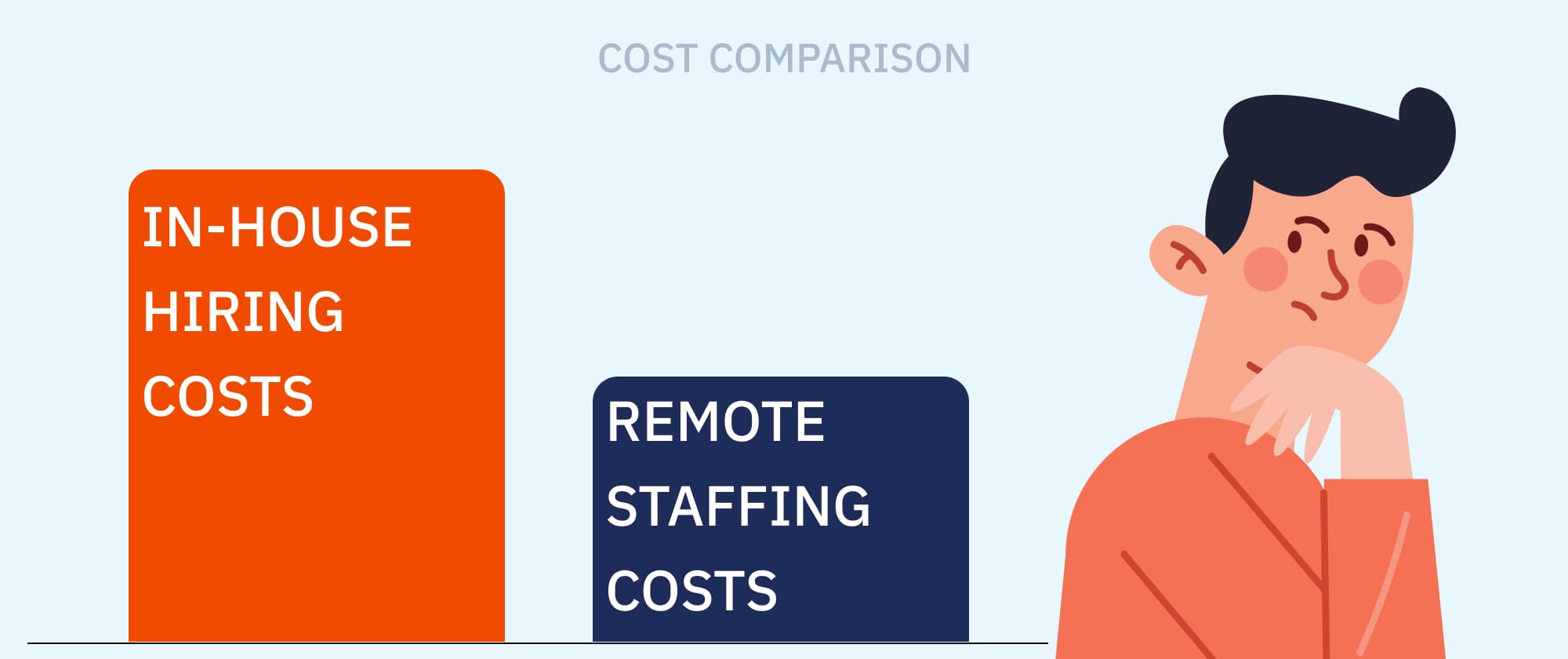
The financial difference between in-house hiring and remote staffing is one of the most visible – but also one of the most nuanced – considerations for leadership teams.
Rising U.S. compensation packages have made it increasingly expensive to hire senior engineers directly. When fully loaded costs are accounted for, the total annual investment can easily reach 50–100% above base salary, especially in fields like AI, data engineering, DevOps, and cloud architecture.
In-House Hiring Costs
Hiring internally means covering not only salary, but also:
- Recruitment expenses
- Benefits and insurance
- Taxes
- HR operations
- Onboarding and training
- Equipment and office costs
- Long-term employment liabilities
For high-end engineering roles, total annual cost escalates quickly. A single mis-hire can multiply the impact further, as replacing a senior engineer often means repeating the entire process – and delaying delivery.
Remote Staffing Through Happen Technologies
Remote staffing through a specialized partner operates on a fundamentally different cost structure. Companies pay a predictable monthly fee that includes talent, management, compliance, and operational support. No recruitment fees, no local taxes, and no long-term overhead.
For companies seeking elite engineering talent, strategic partners often provide access to senior specialists at significantly lower cost – especially in advanced sectors like AI, automation, data processing, and high-scale backend systems.
This model does not argue that cheap alternatives don’t exist locally; rather, it highlights that premium engineers sourced globally can be dramatically more cost-effective than their U.S. equivalents.
Speed – How Fast Can You Actually Scale?
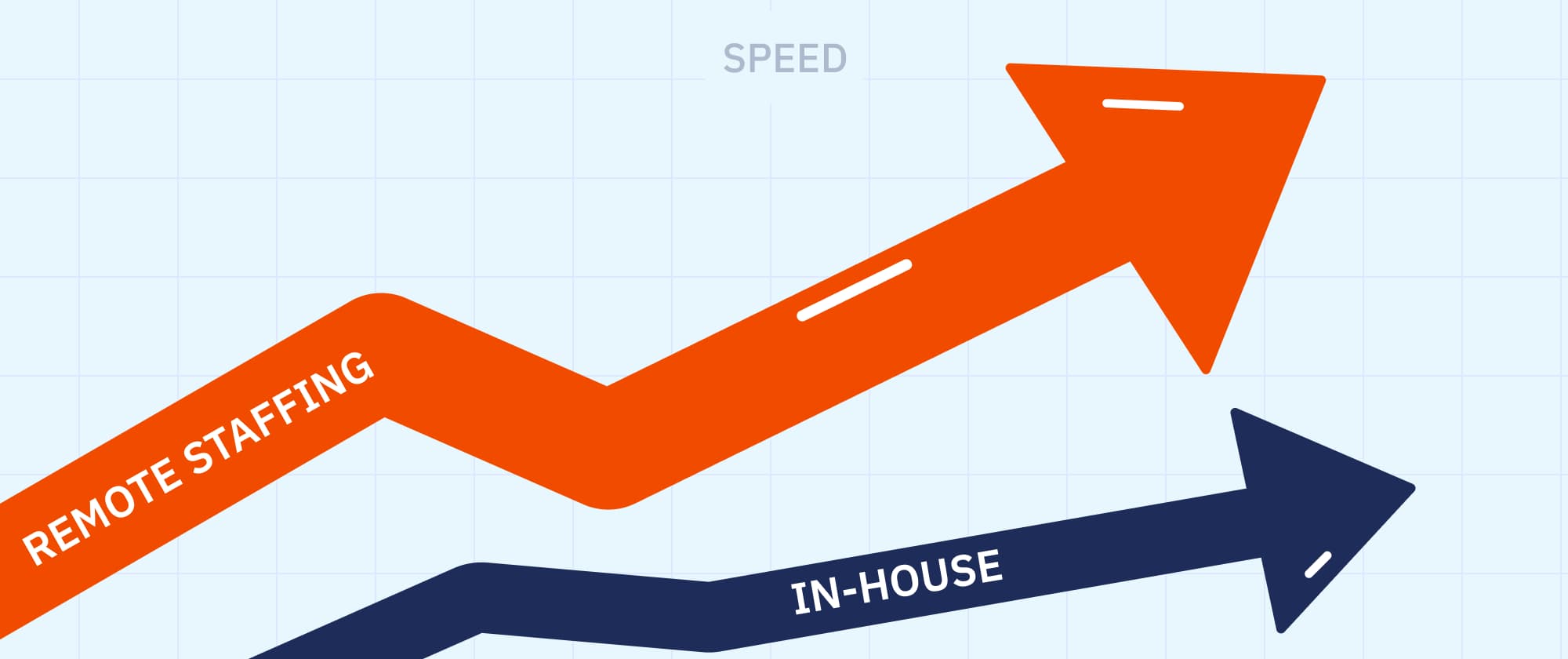
Scaling internal teams takes time – often longer than leadership expects. Recruiting, interviewing, offer cycles, notice periods, and onboarding can stretch timelines by many weeks or even months.
Remote Staffing
Remote staffing allows companies to scale teams much faster than traditional hiring. Instead of going through a lengthy recruitment cycle, organizations can access pre-vetted professionals who are ready to join projects quickly.
Because sourcing, screening, and administrative processes are already handled by the staffing partner, companies can significantly shorten the time between identifying a need and bringing someone on board. In many cases, new team members can start within days or weeks, helping businesses respond quickly to changing workloads or new opportunities.
In-house
Building an in-house team typically takes much longer. The process usually begins with defining the role, posting job listings, sourcing candidates, and reviewing applications before moving into multiple interview rounds and internal approvals.
Even after a candidate accepts an offer, notice periods can delay the start date by several weeks or months. Once the new hire joins, onboarding and ramp-up time are required before they become fully productive, which further extends the timeline for scaling the team.
Flexibility & Scalability – A Modern CTO’s Competitive Advantage
Scalability is where the fundamental contrast between the two models becomes stark. Internal teams are inherently rigid. Once hired, headcount becomes a fixed cost, whether the workload remains constant or not.
Remote staffing models provide elasticity. Companies scale teams based on actual demand, not assumptions:
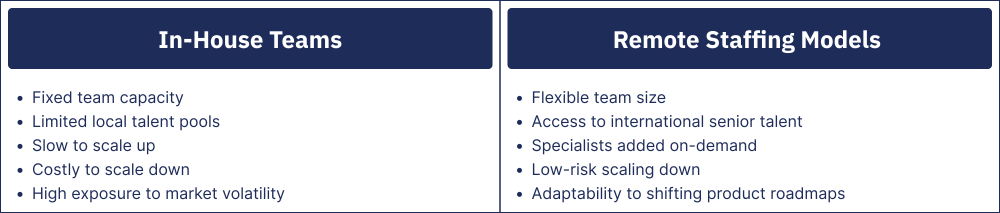
For CTOs navigating unpredictable market conditions, the ability to adjust team composition quickly – without destabilizing the organization – is a significant strategic advantage.
Quality & Talent Access – The Hidden Power of Remote Staffing
Quality is often perceived as the biggest risk in remote models – but in practice, high-end remote staffing partners focus exclusively on senior, highly vetted engineers. This creates access to premium talent that is often unavailable or prohibitively expensive in local markets.
Countries such as Ukraine, Poland, Romania, and parts of Latin America have become hubs for top-level engineering talent, particularly in fields such as:
- Fintech
- AI and machine learning
- Data engineering
- MedTech and HealthTech
- SaaS platforms
- IoT and embedded systems
Strategic partners operating in these regions serve as “filters,” ensuring companies only work with experienced professionals capable of integrating seamlessly into U.S. engineering cultures and processes.
Risk Reduction – The Silent Factor Most Executives Overlook
While cost and speed dominate most hiring conversations, risk remains the most consequential factor for long-term technology performance. Many organizations underestimate how profoundly hiring decisions – and hiring model choices – shape delivery risk, financial exposure, and operational stability.
Remote staffing models, particularly when executed through experienced partners, lower risk in several key areas.
Reduced Hiring Risk Through Curated Senior Talent
Internal hiring remains a high-stakes proposition. Even with rigorous interview cycles, predicting performance and fit is difficult. A single mis-hire in a senior role can stall product delivery, complicate architecture decisions, and require months to correct.
Strategic staffing partners mitigate this risk by supplying only proven, senior-level engineers who have established track records. If performance concerns arise, replacements are swift – avoiding long, costly delays.
Operational Risk Reduction
Companies hiring internally must navigate HR compliance, payroll regulations, benefits, contractor classification, equipment logistics, and legal frameworks across multiple jurisdictions.
A staffing partner absorbs those responsibilities entirely, reducing corporate exposure across HR, legal, financial, and administrative dimensions.
For your company, this means your risk exposure decreases dramatically across compliance, legal, and financial dimensions. You remain focused on building your product – not managing the complexities of international hiring.
Business Continuity & Redundancy
Internal teams often lack redundancy, especially in specialized roles. If a core engineer steps away unexpectedly, product timelines can suffer.
Remote staffing models introduce stability by enabling temporary resource support, shared knowledge documentation, and rapid substitution when needed – all without the hiring overhead.
Strategic Flexibility (the most underestimated risk factor)
Market conditions change. Funding changes. Priorities change. Sometimes product direction changes completely.
In-house teams are fixed. They’re difficult – and expensive – to adjust.
Remote staffing gives you:
- The ability to scale up when competition heats up
- The ability to scale down when budgets shift
- Access to specialized roles only when you need them (DevOps, Data, QA, Security)
- A structure that allows you to pivot without disrupting your organization
This flexibility dramatically reduces the long-term financial risk associated with committing to fixed in-house headcount.
Reduced Delivery Risk Through Experienced Engineering Teams
When working with Happen Technologies, you’re not only getting engineers; you’re getting a team that has built products for US startups, enterprises, and scaling businesses across multiple industries.
This decreases delivery risk in three ways:
- Faster problem identification – senior engineers immediately recognize architectural issues, weak assumptions, or inefficient processes.
- More stable delivery pipelines – our teams follow mature engineering processes that reduce unpredictability.
- Better roadmap accuracy – executives get realistic estimates based on prior experience, lowering the risk of missed milestones.
Productivity & Efficiency – Why Remote Teams Often Deliver More
Remote staffing teams, especially those operating in dedicated models, often outperform in-house teams in terms of pure delivery efficiency. Several factors contribute to this:
- fewer internal meetings
- stronger focus on output rather than hours
- reduced office distractions
- unified communication and documentation standards
- alignment around long-term product ownership
- mature remote work culture (especially in Eastern Europe)
Because teams from Happen Technologies operate as dedicated units, their incentives and workflow are tailored toward consistent delivery and long-term product success.
When Remote Staffing Makes More Sense Than In-House Hiring
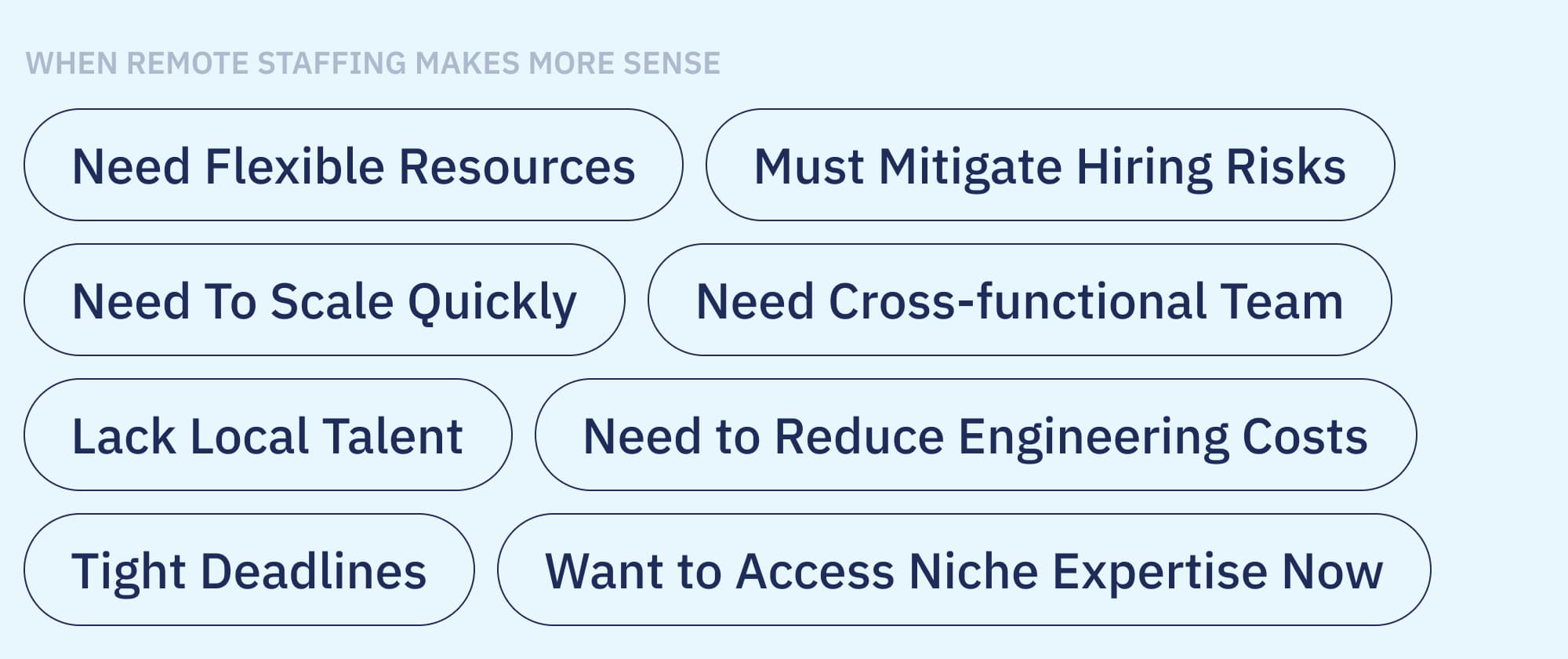
Remote staffing is the superior choice when companies:
- need to scale quickly
- lack local talent availability
- want to reduce engineering costs
- face tight deadlines
- need temporary or flexible resources
- must mitigate hiring risks
- want to access niche expertise immediately
- need a cross-functional team (BA, QA, UI/UX, DevOps, PM)
In-house hiring is ideal for:
- roles requiring deep company-specific knowledge
- leadership and executive engineering roles
- positions involving sensitive data requiring onsite presence
For most scaling scenarios, however, remote staffing is the more strategic choice-especially.
Case Example – A CEO’s Perspective on Scaling with Remote Teams
Imagine a growing SaaS company that just raised Series A funding. They need to scale their engineering team quickly to meet investor deadlines and deliver promised features. The CTO attempts to hire locally but faces shortage, long interview cycles, and budget constraints.
Instead of waiting three months for one engineer, they hire a 4-person remote team through Happen Technologies in under two weeks. The team includes a Backend Engineer, Frontend Engineer, UI/UX Designer, and QA Specialist. They integrate with the existing in-house team, deliver ahead of schedule, and cost 50% less than hiring four US-based engineers.
This example mirrors the reality of dozens of tech companies scaling efficiently through remote teams.
Summary – Why CEOs and CTOs Choose Happen Technologies
Remote staffing has shifted from being an alternative hiring model to a strategic advantage. For companies under pressure to innovate, scale, and compete globally, remote teams offer speed, agility, stability, and financial efficiency that traditional hiring often cannot match.
Happen Technologies enables companies to:
- access elite engineering talent
- scale fast with predictable costs
- reduce operational and hiring risks
- accelerate delivery timelines
- remain competitive in demanding markets
- build long-term dedicated teams aligned with product goals
When expanding your team, especially in uncertain or high-growth periods, remote staffing provides clarity, confidence, and control-something every CEO and CTO needs.
Ready to Scale Your Team?
Happen Technologies builds high-performing remote engineering teams for US-based companies using talent from Eastern Europe and Latin America. Whether you need a single senior engineer or a fully cross-functional team, we help you scale quickly and strategically.